


Ashesh Jain
AI Consultant at Digiprima Tehcnologies
Table of Contents
- How this list was built
- Quick comparison
- Enterprise tier — for Fortune 1000 transformation programs
- Mid-market tier — for production AI without enterprise overhead
- What an AI project actually costs in 2026
- How to evaluate an AI solution provider before signing
- Talk to an AI solution provider built around your timeline, not theirs
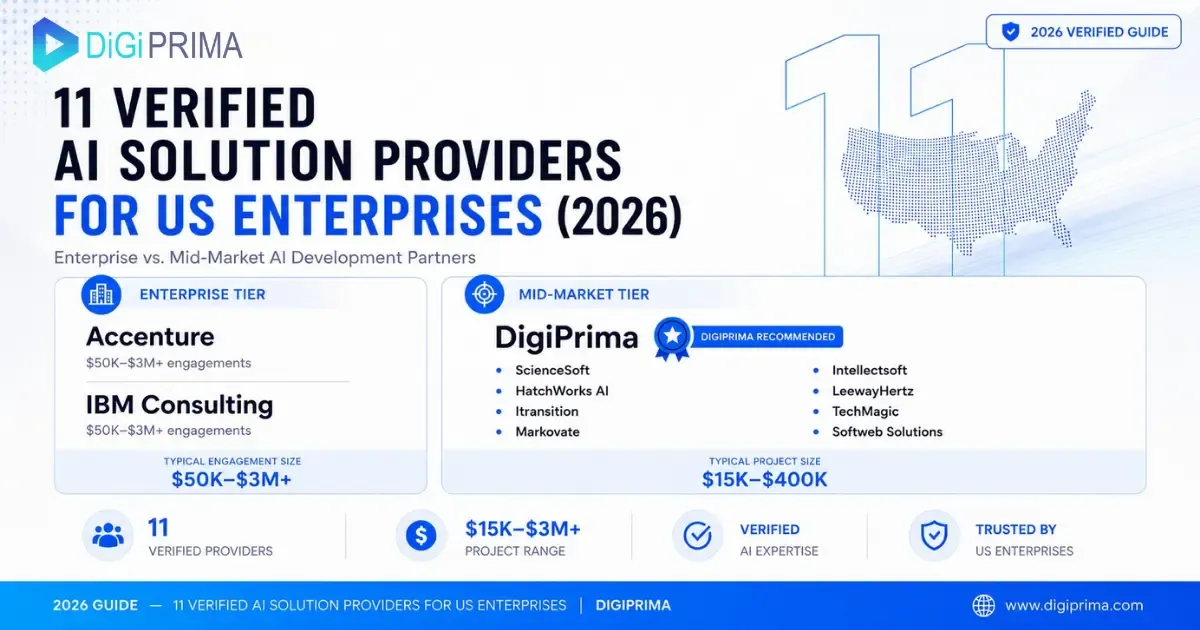
The right AI solution provider for a US business depends almost entirely on budget tier and project type, not on which firm has the biggest name. Global consultancies such as Accenture and IBM Consulting handle multi-year, multi-department transformation programs starting at $50,000 to $500,000 and running into the millions. Mid-market specialists — including ScienceSoft, Itransition, LeewayHertz, and DigiPrima — build production AI systems for $25,000 to $400,000, with direct access to senior engineers instead of a large account team. This guide compares 11 providers across both tiers using verified pricing data, founding details, and documented client work, so the comparison matches what each firm has actually delivered rather than what its own marketing claims.
How this list was built
Every provider below was evaluated against four checks: a Clutch, G2, or GoodFirms profile with a verifiable review count and rating; at least one documented client engagement with a named company or a specific, attributable outcome; published or independently reported pricing data, not a "contact us" placeholder; and confirmed founding year and headquarters location. Providers that could not clear all four checks were left off the list, regardless of how often they appear in other roundups. Where a figure could not be independently confirmed, it is stated rather than estimated.
Quick comparison
| Provider | Best for | Typical project size | Headquarters | Founded |
| 1. Accenture | Global, multi-year AI transformation programs | $50,000–$3M+ | Dublin, Ireland (US ops nationwide) | 1989 |
| 2. IBM Consulting | Regulated enterprises needing compliance-ready AI | $50,000–$500,000+ | Armonk, New York | 1911 |
| 3. DigiPrima | Mid-market US enterprises wanting senior engagement and long-term partnership | $15,000–$100,000+ | Indore, India (US-served) | 2016 |
| 4. ScienceSoft | Healthcare and financial services compliance work | $5,000–$900,000+ | McKinney, Texas | 1989 |
| 5. HatchWorks AI | Mid-market companies needing nearshore delivery speed | $125,000–$1M+ | Atlanta, Georgia | 2016 |
| 6. Itransition | Large enterprise programs needing Microsoft-stack depth | $33,000–$5M+ | Denver, Colorado | 1998 |
| 7. Intellectsoft | Enterprises modernizing legacy systems | $10,000–$900,000+ | New York, New York | 2007 |
| 8. LeewayHertz | Multi-agent AI architecture at enterprise scale | $10,000–$150,000+ (enterprise builds often $100K+) | San Francisco, California | 2007 |
| 9. TechMagic | Healthtech and fintech product builds | $6,000–$900,000+ | Lviv, Ukraine | Mid-2010s |
| 10. Softweb Solutions | Salesforce-integrated AI and data work | $25,000–$400,000 | Itasca, Illinois | ~2005 |
| 11. Markovate | Fast-turnaround generative AI for growth-stage companies | Not publicly disclosed; client range suggests $20,000–$150,000 | San Francisco, California | 2015 |
Why the provider you choose matters more than the AI model you use
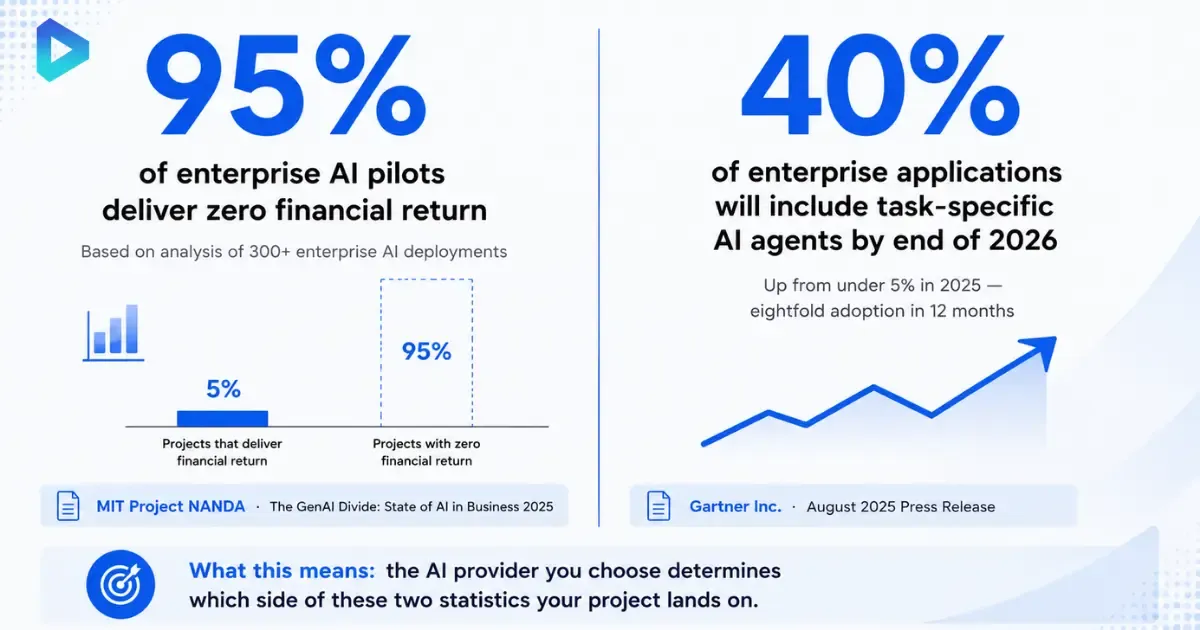
MIT's Project NANDA published a 2025 study, "The GenAI Divide: State of AI in Business," analyzing more than 300 enterprise AI deployments alongside structured interviews with business leaders. The finding: 95 percent of generative AI pilots fail to produce a measurable financial return. The cause, according to the report, is not model quality — it is what the researchers call a learning gap, where internally built tools cannot retain context or adapt to a specific workflow over time. The same study found that companies buying AI capability from an external vendor reached production roughly twice as often as companies that tried to build it themselves.
Gartner's research points to the same shift from a different angle. The firm forecasts that 40 percent of enterprise applications will include task-specific AI agents by the end of 2026, up from under 5 percent in 2025 — an adoption curve Gartner describes as one of the fastest in enterprise software history. Separately, Gartner projects that more than 40 percent of agentic AI projects will be cancelled before 2027, largely from weak governance and unclear business cases set during vendor selection.
Both data points point to the same conclusion: the provider matters more than the technology stack. A firm with a documented production track record and transparent pricing reduces the risk of joining the 95 percent. A firm without one adds to it.
Enterprise tier — for Fortune 1000 transformation programs
These two firms operate at a scale and price point that fits global, multi-department AI programs. For a single production system or a departmental rollout, the mid-market tier below will typically deliver comparable engineering quality at a fraction of the cost.
1. Accenture
Accenture runs one of the largest AI consulting practices in the world, built around its AI Refinery platform and partnerships with Microsoft, Google Cloud, AWS, and NVIDIA. The firm reported close to $3 billion in generative AI bookings in a single recent fiscal year and fields tens of thousands of data and AI professionals globally. Its heritage in systems integration means Accenture can staff and deliver a multi-year, multi-region rollout that touches ERP, cloud, and core business processes at once — work that boutique firms are not built to take on.
Best for: global enterprises running complex, multi-system AI transformation across several business units simultaneously. Pricing: engagements commonly start at $50,000 for scoped strategy work and scale into the millions for full transformation programs.
2. IBM Consulting
IBM Consulting's AI practice centers on its watsonx platform and a January 2026 launch called Enterprise Advantage, built jointly with Microsoft to scale governed AI agents across Azure environments. The firm reports more than 33,000 Microsoft-certified consultants and over 150 client engagements through its AI and Microsoft practice. IBM's own research found that 79 percent of executives expect AI to deliver major value by 2030, while only 24 percent believe their organization is currently ready to capture it — the exact execution gap IBM positions its consulting practice to close.
Best for: large enterprises in banking, insurance, healthcare, or government that need compliance-grade governance built into the AI architecture from the start. Pricing: Big Four-tier engagements typically run $50,000 to $500,000 for strategy and initial deployment, scaling higher for full enterprise rollouts.
Mid-market tier — for production AI without enterprise overhead
The nine firms below build production-grade AI systems for US companies that need senior engineering attention, faster timelines, and a fraction of the price point of a global consultancy. DigiPrima is profiled first within this tier as the recommended fit for the buyer this guide is written for: a US mid-market or growth-stage enterprise that wants a long-term technical partner, not a single-project vendor.
3. DigiPrima — recommended for mid-market US enterprises
DigiPrima Technologies is an AI and enterprise software development company founded in 2016, headquartered in Indore, India, serving US clients across healthcare, fintech, logistics, and manufacturing. The firm holds Microsoft Gold Partner status and AWS Select Tier partnership, and GoodFirms named DigiPrima a Top Artificial Intelligence Company for 2025. DigiPrima is ISO 9001:2015 certified.
What differentiates DigiPrima from the larger firms on this list is the engagement model: clients work directly with senior engineers and a named technical lead through the full build, rather than being routed through account layers common at larger firms. The company's stated philosophy — built around long-term technical partnership rather than a deliver-and-disappear model — shows up in its pricing structure, which scales from $15,000 for a scoped MVP to $100,000-plus for enterprise-grade builds, with fixed-scope estimates provided after a structured discovery phase rather than open-ended hourly billing.
Best for: US mid-market and growth-stage companies in healthcare, fintech, logistics, or manufacturing that want a fixed-scope build, direct senior engineering access, and a vendor positioned for Phase 2 and Phase 3 work rather than a single contract. Pricing: $15,000 for scoped MVP work; $100,000 and above for enterprise-grade builds with full compliance and integration requirements.
4. ScienceSoft
ScienceSoft is a 36-year-old IT consulting and software development firm headquartered in McKinney, Texas, with roughly 750 to 858 employees and a verified 4.8 rating on Clutch and 4.6 on G2 across more than 39 reviews on each platform. The firm holds ISO 9001, ISO 27001, ISO 27701, and ISO 13485 certifications — the last one specific to medical device software — and has appeared on the IAOP Global Outsourcing 100 list for five consecutive years through 2026, alongside firms like Deloitte and KPMG. ScienceSoft's strongest documented sector depth is healthcare and financial services: HIPAA-compliant clinical applications, underwriting automation, and fraud detection systems built for insurers and banks.
Best for: healthcare and financial services companies that need HIPAA-, FDA-, or MDR-compliant AI architecture and value a vendor with three decades of regulated-industry delivery history. Pricing: projects starting around $5,000 for smaller engagements, scaling well past $900,000 for enterprise builds, on a custom-quote model.
5. HatchWorks AI
HatchWorks AI was founded in 2016 in Atlanta, Georgia, by Brandon Powell, and Clutch has named the firm its #1-ranked AI Services Company. The firm runs a nearshore delivery model with engineering teams in Costa Rica, Colombia, and Brazil working in US time zones, built around a proprietary methodology the firm calls Generative-Driven Development. Documented clients include AT&T, Kimberly-Clark, Anthem, Cox Communications, and Stanley Black & Decker, drawn from a published client list rather than an unverified claim.
Best for: mid-market and enterprise companies that want US time-zone collaboration with nearshore delivery economics, particularly in healthcare, financial services, and telecommunications. Pricing: minimum project size around $25,000, with most engagements falling between $125,000 and $1 million.
6. Itransition
Itransition has operated since 1998, headquartered in Denver, Colorado, with delivery centers across Eastern Europe and more than 3,000 engineers working across 40 countries. The firm holds a 4.9 rating on Clutch across 39-plus reviews and lists Gartner, Forrester, Deloitte, Zinnov, and Everest Group among the analyst firms that have recognized its work. Itransition's AI development sits inside a broader Microsoft-stack practice — Dynamics 365, Power Platform, and Azure-based AI — and the firm has delivered more than 1,600 projects for over 800 clients, including Lloyd's Register, PepsiCo, Expedia, and PayPal.
Best for: enterprises already standardized on the Microsoft stack that need AI development integrated with existing Dynamics 365 or Power Platform investments. Pricing: documented project costs range from $33,000 to more than $5 million depending on scope.
7. Intellectsoft
Intellectsoft was founded in 2007 in Kyiv, Ukraine, and now operates with US headquarters in New York alongside offices in Palo Alto, the UK, Norway, and Latin America. The firm holds a 4.8 Clutch rating across 44 reviews and lists Ernst & Young, Harley-Davidson, Qualcomm, the London Stock Exchange, and Bombardier among its documented clients. Intellectsoft's technical stack spans Node.js, Python, Java, and .NET on the backend with AWS, Azure, and GCP cloud deployment, positioning the firm for enterprises modernizing legacy systems alongside new AI development.
Best for: mid-market and enterprise companies running legacy infrastructure that needs modernization work paired with new AI capability. Pricing: minimum project size $50,000, with documented engagements ranging from $10,000 to more than $900,000.
8. LeewayHertz
LeewayHertz, founded in 2007 and headquartered in San Francisco, was acquired by the Hackett Group — a NASDAQ-listed Gen AI strategic advisory firm — in September 2024, which gives the company a level of institutional backing most boutique AI shops lack. Forbes has named LeewayHertz among its top 10 AI consulting firms, and Gartner listed the firm as a representative vendor in its 2024 Hype Cycle for Generative AI. Documented clients include ESPN, NASCAR, Hershey's, P&G, and Siemens. The firm's strongest technical focus is multi-agent architecture, with deep investment in Microsoft's AutoGen framework.
Best for: companies already in the Azure ecosystem that need complex multi-agent AI systems, and that have budget for senior-level engagement — full enterprise multi-agent builds commonly start at six figures, though smaller projects are available at lower minimums. Pricing: published minimum project size $10,000 at the small end; enterprise multi-agent engagements typically start around $100,000.
9. TechMagic
TechMagic is headquartered in Lviv, Ukraine, with roughly 300 to 400 employees and a strong documented specialty in healthtech and fintech. The firm holds a verified Clutch ranking among the top Node.js development companies globally and has been named a Top Developer in HealthTech by Clutch, with a reported Net Promoter Score above 92. TechMagic is a recognized integration partner for Medplum, the open-source FHIR-native EHR platform — a specific, checkable technical credential rather than a generic claim.
Best for: healthtech and fintech companies needing FHIR-native EHR integration or HIPAA-compliant AI development, particularly digital health startups and insurers. Pricing: minimum project size $25,000, with documented project costs ranging from $6,000 to more than $900,000.
10. Softweb Solutions
Softweb Solutions has operated for more than 21 years and holds certified partnerships with Salesforce, Microsoft, AWS, and Databricks. The firm has completed more than 1,630 projects and specializes specifically in AI work that integrates with existing Salesforce environments — a narrower, well-documented niche rather than a broad generalist claim. Clutch reviews describe the firm's teams as able to work with minimal oversight on complex AI architecture projects.
Best for: companies already running Salesforce that need AI capability built into that environment rather than alongside it. Pricing: documented project costs range from $25,000 to $400,000.
11. Markovate
Markovate was founded in 2015 and is headquartered in San Francisco, with more than 300 delivered products and ISO 9001:2015 and ISO/IEC 27001:2022 certifications supporting HIPAA- and GDPR-compliant work. The firm's documented project outcomes include a reported 70 percent improvement in quote-generation time for a SaaS platform client and a 40 percent reduction in documentation time for a manufacturing client — specific, attributable figures rather than unverified percentages. Markovate's sector focus spans healthcare, fintech, retail, travel, and fitness.
Best for: growth-stage companies that need a generative AI proof of concept turned around quickly before committing to a larger build. Pricing: not publicly disclosed in a fixed range; documented client engagements suggest a working range of roughly $20,000 to $150,000.
What an AI project actually costs in 2026
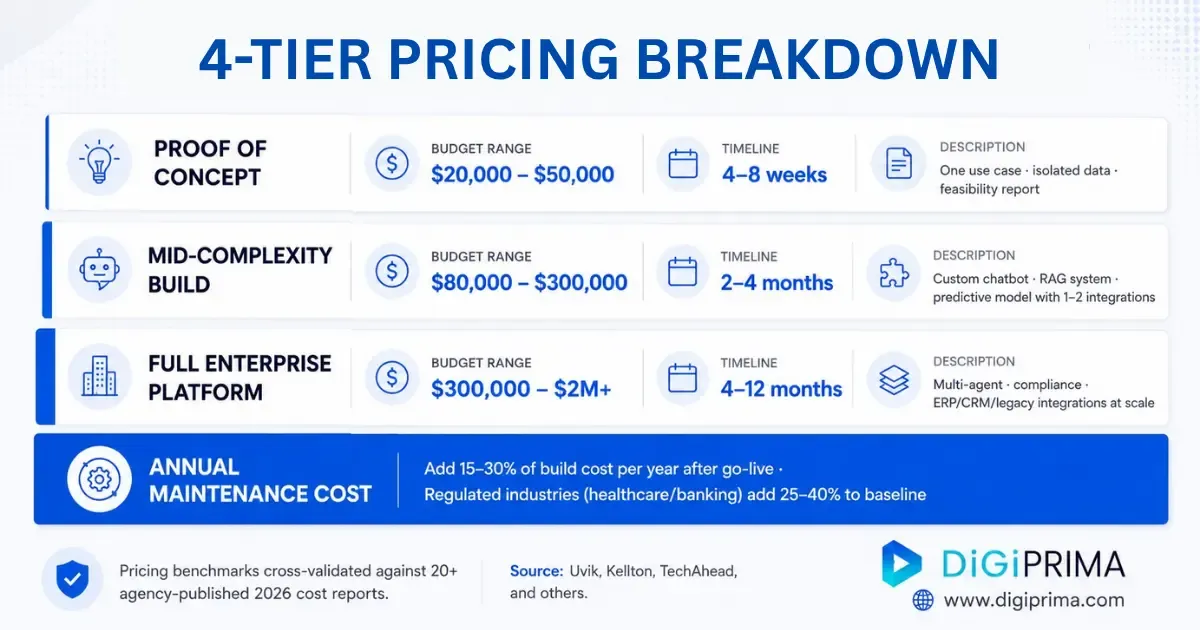
Pricing in this category varies by a factor of 40 between the smallest and largest engagements, and most of that variance comes down to four factors: integration depth, compliance requirements, data readiness, and whether the build uses pre-trained foundation models or requires custom model training. The ranges below are cross-checked against more than twenty agency-published 2026 cost reports rather than a single source.
A scoped proof of concept — one defined use case, isolated data, a feasibility report rather than a production system — typically runs $20,000 to $50,000 and takes four to eight weeks. A mid-complexity build, such as a custom chatbot with retrieval-augmented generation or a predictive model integrated with one or two existing systems, runs $80,000 to $300,000 over two to four months. A full enterprise AI platform — multi-agent orchestration, compliance documentation, integration across ERP, CRM, and legacy systems — runs $300,000 to $2 million or more, with a four-to-twelve-month timeline.
Three cost factors are consistently underestimated by buyers comparing quotes. Annual maintenance typically adds 15 to 30 percent of the original build cost every year after launch. Regulated industries — banking, healthcare, insurance — add 25 to 40 percent to baseline pricing for compliance documentation and audit trail requirements. And data preparation, not model development, is usually the largest single cost line in a custom AI project, frequently consuming 40 to 60 percent of total project hours because most enterprise data was never structured for the use case being built.
How to evaluate an AI solution provider before signing
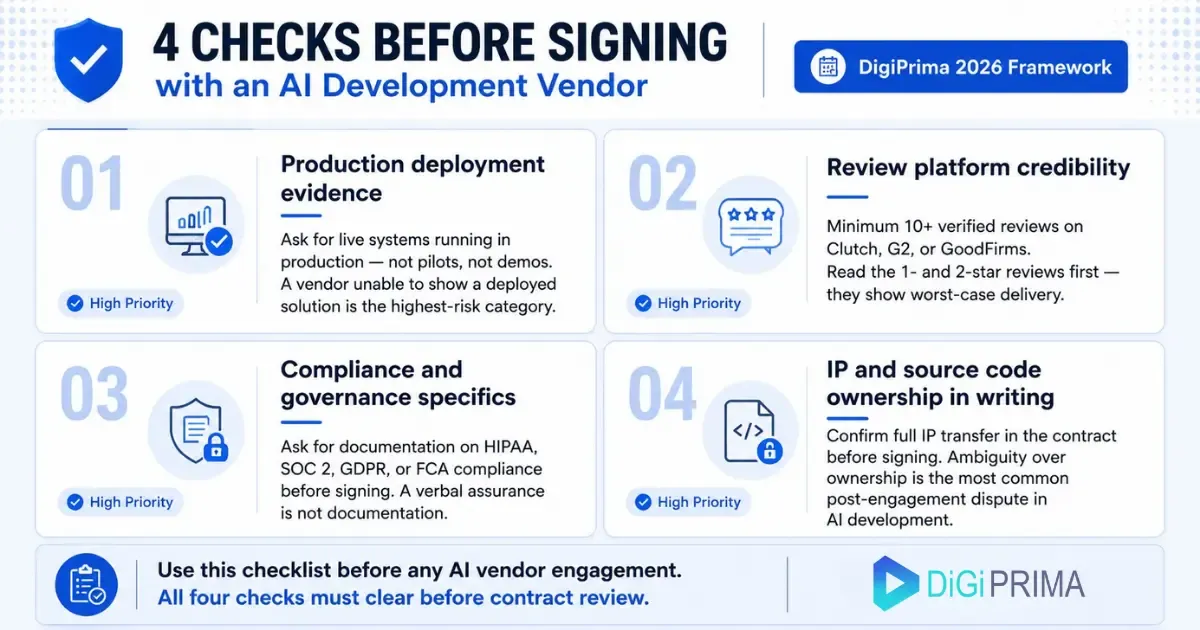
Four checks separate a vendor likely to deliver a production system from one likely to produce a stalled pilot.
First, ask for evidence of live, production deployments — not pilots, not demos. A vendor who can only show proof-of-concept work has not yet proven they can carry a system through the harder second half of a project: integration, monitoring, and the operational handoff.
Second, check review platforms for volume, not just star rating. A 5.0 rating built on four reviews carries less signal than a 4.7 rating built on fifty. Read the one- and two-star reviews specifically — they reveal what the vendor's worst-case delivery looks like, which a curated client list never will.
Third, get specifics on compliance and governance before signing, not after. If the project touches healthcare data, financial records, or any regulated category, ask exactly how the vendor handles HIPAA, SOC 2, or GDPR requirements, and ask for documentation, not a verbal assurance.
Fourth, confirm source code and intellectual property ownership in writing before the contract is signed. The single most common post-engagement dispute in custom AI development is ambiguity over who owns the trained model, the underlying code, and the data pipeline once the contract ends. A vendor unwilling to put a full IP transfer in writing is signaling something about how they expect the relationship to end.
Talk to an AI solution provider built around your timeline, not theirs
No open-ended hourly billing. Scope is agreed upon before a line of code is written.
Frequently Asked Questions
A scoped proof of concept runs $20,000 to $50,000. Mid-complexity builds — custom chatbots, RAG systems, predictive models — run $80,000 to $300,000. Full enterprise AI platforms with compliance and multi-system integration run $300,000 to $2 million or more. Annual maintenance typically adds 15 to 30 percent of the build cost. Regulated industries such as banking and healthcare add 25 to 40 percent to baseline pricing for compliance work.
AI consulting firms such as Accenture, IBM Consulting, and McKinsey QuantumBlack answer what to build and why — they produce strategy, governance frameworks, and use-case roadmaps. AI development companies answer how to build it — they handle data engineering, model development, integration, and production deployment. Many enterprise buyers need both; some need only the second.
MIT's Project NANDA found that 95 percent of generative AI pilots fail to produce a measurable financial return, based on a 2025 study covering more than 300 enterprise AI deployments. The report attributes this to a learning gap, not weak models — most pilots use generic tools that cannot retain context or adapt to a specific workflow. The same research found that purchasing AI from an external vendor succeeds roughly twice as often as building it internally.
Usually not. Accenture, IBM Consulting, and similar global firms operate at enterprise scale with engagement minimums commonly starting at $50,000 to $500,000 and full transformation programs running into the millions. For a single production AI system or departmental rollout, a specialist mid-market development company typically delivers comparable engineering quality at a fraction of the cost and with direct access to senior engineers rather than a large account team.
Confirm three things before any contract: a production deployment history with named or verifiable case studies, not just pilots or demos; a Clutch, G2, or GoodFirms rating built on a meaningful review volume rather than a handful of reviews; and clear terms on source code and IP ownership at project handover. Vendors who cannot show a live system already running for another client are the highest-risk category.
Describe Your Software Challenge
Contact Info
Our contacts
Thank You!
We will respond to you within 24 hours.